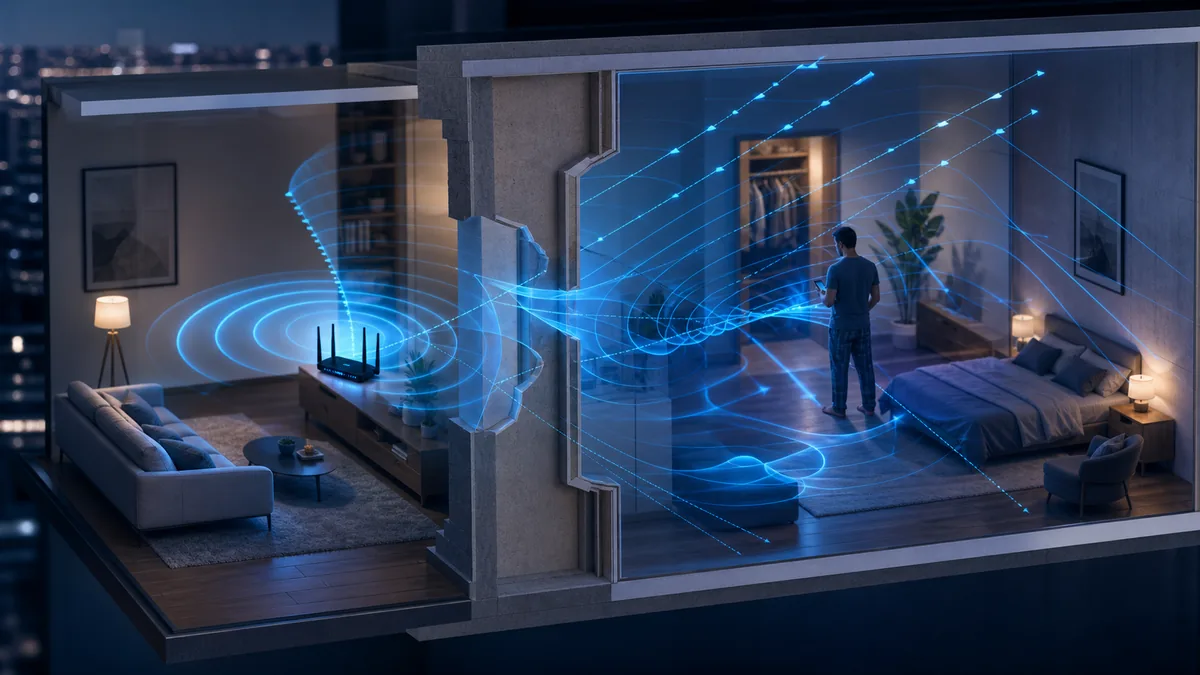
The short answer is yes, radio signals can travel through some walls, but no, ordinary WiFi does not let a person visually see through a wall. A sensing system needs a known transmitter, a compatible receiver, measurements such as Channel State Information, a model trained for a narrow task, and validation in the actual room.
The useful question is whether signal changes contain enough evidence for a defined output such as occupied versus empty, moving versus still, or a coarse body pose. Reliability depends on wall material, frequency, placement, interference, calibration, and the people included in testing.
A practical test plan before trusting the result
Begin with a written claim that can be proven or rejected. For example: the system should distinguish an empty room from one walking person through one documented drywall partition at a fixed distance. Avoid starting with broad goals such as seeing people through walls, because there is no clear success condition and almost any visualization can look convincing.
Record the transmitter and receiver model, antenna arrangement, firmware, frequency band, channel width, sampling rate, wall material, wall thickness, room dimensions, device height, and distance from the wall. Photograph or sketch the placement so the same geometry can be repeated. If the system uses a trained model, record which rooms, people, activities, and wall types appeared in the training data.
Collect an empty-room baseline long enough to observe normal drift and interference. Then capture repeated trials for movement, stillness, entry, exit, and any target activity. Randomize the order so the operator cannot unconsciously tune the result. Include negative controls such as movement on the transmitter side, a fan, a closing door, another WiFi network, or a pet when those conditions are realistic.
Separate calibration data from evaluation data. A model that performs well on the same recordings used to choose thresholds has not demonstrated generalization. Reserve different times, people, placements, and ideally another room for the final test. Report the number of trials, not only the best examples, and keep failures visible.
Finally, decide what happens when confidence is low. A safe interface should show unknown, insufficient signal, or recalibration required rather than forcing a human-shaped output. Define a review process before deployment and repeat the baseline after furniture, router, firmware, or occupancy patterns change.
- Write one measurable claim and one failure condition.
- Document geometry, hardware, radio settings, and wall construction.
- Use empty-room controls and realistic interference tests.
- Hold out unseen people, times, placements, or rooms.
- Publish confusion counts, latency, and low-confidence behavior.
How WiFi signals get through a wall
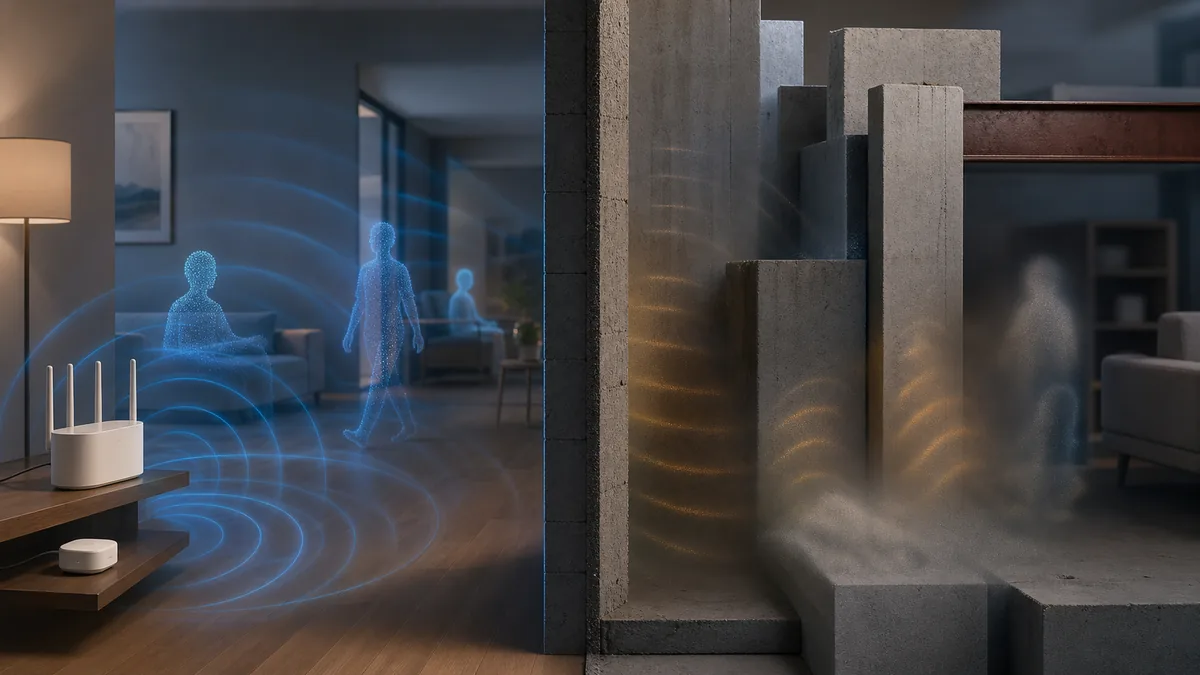
A transmission reaches the receiver along many paths. Some energy passes through drywall or wood, while other parts reflect from concrete, metal, furniture, doors, and people. The receiver observes the combined result rather than a clean ray.
CSI exposes amplitude and phase across subcarriers. Movement changes some paths, and a model compares those changes with labeled examples. It estimates a target; it does not reconstruct a photograph.
| Material | Typical effect | Practical meaning |
|---|---|---|
| Drywall or wood | Moderate attenuation | Short indoor paths may remain usable |
| Brick or dense concrete | Stronger loss and multipath | Range and repeatability drop |
| Metal or foil insulation | Strong reflection or blocking | The link may fail |
| Doors and openings | Variable transmission | Small changes alter the baseline |
What through-wall WiFi sensing may detect
Research systems have demonstrated presence, motion, respiration patterns, activity classes, localization, and coarse pose estimation. Each result is task-specific; a walking classifier does not automatically identify a person or work in every building.
- Room or zone occupancy with a stable baseline.
- Movement or stillness inside a tested range.
- Coarse activity or pose classes with suitable training data.
- Breathing-related periodic changes under controlled conditions.
- Approximate location with enough links or antennas.
What WiFi cannot reliably show
A consumer router does not produce a live picture behind a wall. Fine facial details, clothing, identity, exact health status, and intent are not directly visible in CSI.
A crisp skeleton is a model visualization and may use live data, replay, simulation, or illustration. Ask what hardware produced the input and whether the result survives a new room or participant.
- No photographic or X-ray image.
- No dependable identity from ordinary CSI.
- No guaranteed detection through every material.
- No medical or emergency decision without validated specialist systems.
How to evaluate a through-wall demo
Confirm the chipset, firmware, channel, receiver, sampling process, model, and target label. Test an empty room, known movements, stillness, changed placement, and an unseen participant.
Report false positives, false negatives, latency, and low-confidence periods. A credible system should sometimes say it does not know. Repeatability across days matters more than one striking clip.
| Check | Better evidence | Warning sign |
|---|---|---|
| Hardware | Documented CSI receiver | Only a router dashboard |
| Geometry | Known device positions | Devices move constantly |
| Validation | New rooms and people | One polished demo |
| Confidence | Uncertain state is visible | Every frame looks certain |
| Wall | Material and thickness recorded | Generic through-wall promise |
Privacy, consent, and safe use
Camera-free sensing is not privacy-free. Occupancy, routines, sleep, movement, and location can still be sensitive. People should know what is measured, why it is collected, who can access it, and how to disable it.
Do not use experimental WiFi sensing as the sole basis for medical, emergency, policing, employment, or safety decisions. Prefer local processing, minimal retention, access controls, visible uncertainty, and human review.
- Use the minimum sensing resolution needed.
- Obtain consent and provide an off switch.
- Separate research demos from production claims.
- Document unsupported uses and retention limits.
Sources and technical references
Through-Wall WiFi Sensing FAQ
Can a normal WiFi router see through walls?
No. It sends signals through some walls but does not create an image. Sensing requires compatible hardware, CSI access, models, and validation.
Can WiFi detect a person in another room?
It may estimate presence or motion across a tested wall and range, but materials, placement, interference, and calibration control reliability.
Can WiFi show a body pose through a wall?
Research has demonstrated coarse pose estimation, but the output is probabilistic and not equivalent to a camera image.
Which walls block WiFi sensing most?
Metal, foil insulation, reinforced concrete, dense masonry, and multiple thick barriers usually cause the greatest loss.
Is through-wall WiFi sensing legal?
Rules vary. Monitoring people without notice or consent can create privacy, employment, tenancy, or data-protection issues.