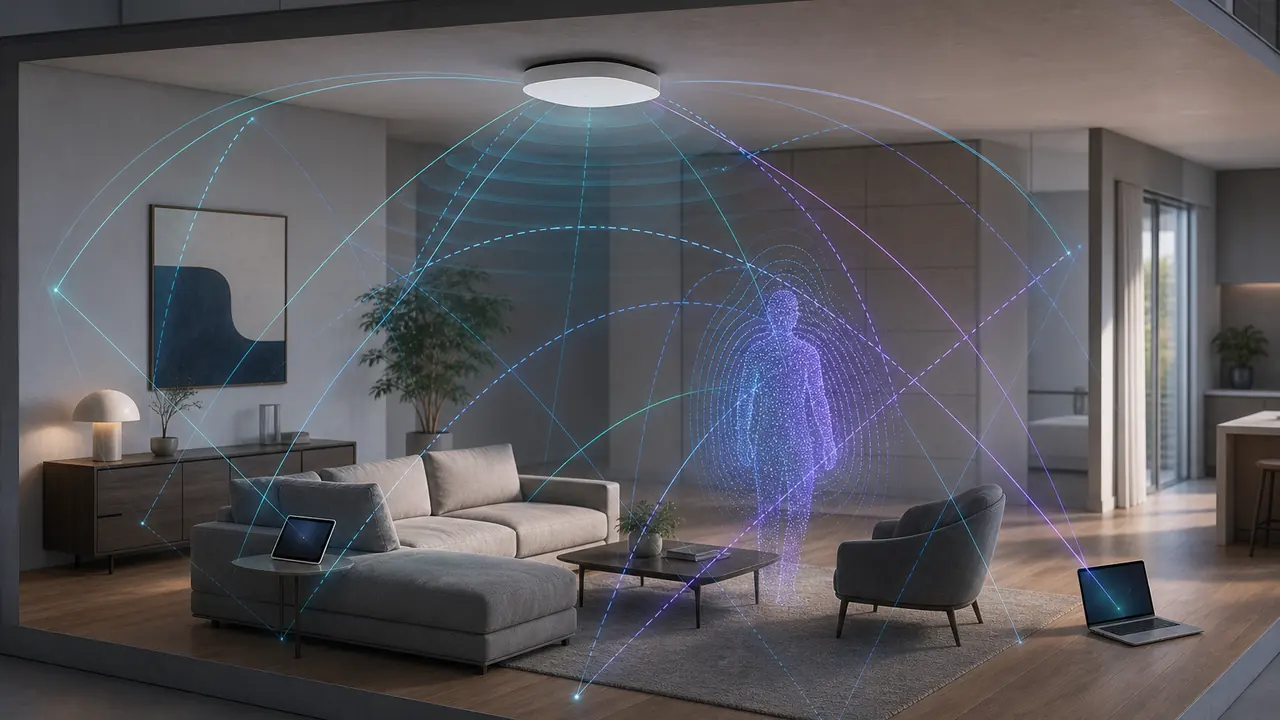
The short answer: IEEE 802.11bf-2025 is now an active published amendment for WLAN sensing. It defines interoperable procedures that let Wi-Fi stations use radio measurements to observe changes in an environment. The standard was published on September 26, 2025, so articles that still describe 802.11bf only as a future task-group project are outdated.
The important boundary is equally clear. IEEE 802.11bf does not promise camera-quality images, medical diagnosis, perfect through-wall detection, or automatic support on existing routers. It supplies a common measurement and signaling foundation. Hardware capabilities, firmware, antennas, channel conditions, sensing algorithms, training data, and validation still determine what a real system can detect.
IEEE 802.11bf status and scope at a glance
IEEE lists 802.11bf-2025 as an active standard and an amendment to IEEE 802.11-2024. Its scope covers WLAN sensing operation in license-exempt bands below 7.125 GHz and in the directional 60 GHz band. That matters because the two frequency ranges support very different sensing geometries, ranges, and resolutions.
The amendment focuses on the communication procedures required for sensing: capability discovery, session setup, measurement exchange, reporting, and coordination between participating stations. It creates a shared language for devices, but it does not prescribe one universal machine-learning model or one guaranteed application output.
| Question | Practical answer |
|---|---|
| Is 802.11bf published? | Yes. IEEE published IEEE 802.11bf-2025 on September 26, 2025. |
| What does it standardize? | WLAN sensing procedures, signaling, measurements, and reports between compatible stations. |
| Which frequencies are covered? | License-exempt operation below 7.125 GHz plus directional 60 GHz operation. |
| Does every Wi-Fi router support it? | No. Support requires suitable radio hardware, firmware, drivers, and implementation. |
| Does it define the final AI result? | No. Applications still interpret measurements for presence, motion, gesture, ranging, or other tasks. |
How an 802.11bf Wi-Fi sensing session works
A sensing-capable device first needs to learn what another station supports. The participating devices can then negotiate a sensing configuration, including roles, measurement parameters, and the way results will be returned. One device may initiate the sensing exchange while another responds, but practical implementations can assign measurement and reporting responsibilities in different ways.
During the measurement phase, transmitted Wi-Fi signals travel over direct and reflected paths. People, doors, furniture, and movement change amplitude, phase, delay, Doppler, angle, or related channel characteristics. A compatible station records the requested measurements and returns a report. The application layer then filters those reports, estimates confidence, and maps the signal changes to a use case such as occupancy or gesture detection.
- Discovery: identify sensing capabilities and supported procedures.
- Setup: negotiate roles, timing, channels, and measurement configuration.
- Measurement: transmit or observe frames that expose environmental channel changes.
- Reporting: return standardized measurement information to the requesting station.
- Inference: use separate algorithms to turn measurements into a useful estimate.
What 802.11bf adds beyond proprietary Wi-Fi sensing
Wi-Fi sensing existed before 802.11bf. Research systems and commercial vendors already used RSSI, CSI, fine timing, beam training, or vendor-specific radio telemetry. The problem was fragmentation: one chipset exposed a measurement that another chipset hid, frame exchanges differed, calibration assumptions were unclear, and applications were often tied to one hardware stack.
802.11bf provides a standards-based path for devices to advertise and coordinate sensing functions. That can reduce integration friction and make future multi-vendor systems easier to design. It should not be read as instant interoperability, however. Vendors still need to implement optional capabilities, expose usable APIs, document limits, and pass real-world validation. A standards logo alone is not evidence that a router offers developer-accessible CSI or a production-ready presence detector.
Sub-7 GHz versus 60 GHz sensing
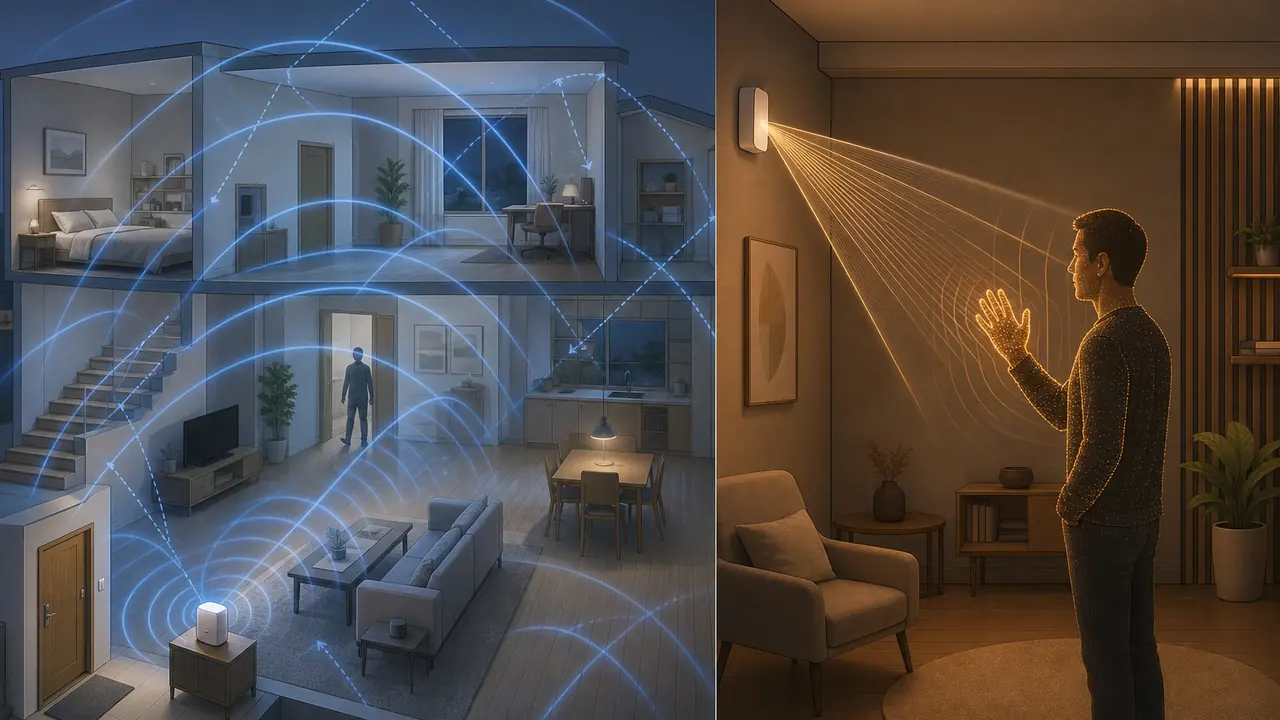
The frequency band changes what a sensing system can reasonably observe. Sub-7 GHz Wi-Fi usually offers broader coverage and better penetration through ordinary interior materials, but multipath can make interpretation difficult and spatial resolution is limited. The 60 GHz band uses much shorter wavelengths and directional beams, which can support finer motion or gesture detail at short range, but blockage and limited coverage become more important.
Neither band is automatically better. Whole-room occupancy, coarse motion, and device reuse may favor sub-7 GHz. Short-range gesture, fine movement, or directional ranging may favor 60 GHz. A credible design starts from the target range, room geometry, privacy requirement, power budget, and acceptable false-alarm rate rather than from the most impressive laboratory demo.
| Design factor | Sub-7 GHz | 60 GHz |
|---|---|---|
| Typical coverage | Broader room or home coverage | Shorter, directional coverage |
| Material penetration | Better through many interior materials | More sensitive to blockage |
| Potential detail | Good for coarse presence and motion | Potentially finer gesture and movement detail |
| Deployment challenge | Multipath complexity and interference | Beam alignment, blockage, and device placement |
| Best starting question | Can broad coverage meet the use case? | Is fine short-range detail worth tighter placement constraints? |
Hardware compatibility: what to verify before buying
An existing Wi-Fi 6, Wi-Fi 6E, or Wi-Fi 7 label does not prove 802.11bf sensing support. The standard was published after many current products were designed, and sensing functions may depend on radio revisions, firmware, driver exposure, and vendor APIs. Some devices may support only selected procedures or keep measurement access inside a closed application.
Before purchasing hardware, ask for the exact chipset and firmware version, the supported 802.11bf roles and bands, API or SDK access, measurement formats, report rates, antenna requirements, calibration guidance, and a documented compatibility statement. If a vendor only shows an occupancy demo without describing the measurement path, treat it as an application claim rather than proof of general developer access.
- Confirm the exact product and radio revision, not only the Wi-Fi generation.
- Request written 802.11bf capability and band support documentation.
- Check whether sensing reports are exposed through a public driver, SDK, or API.
- Verify initiator, responder, measurement, and reporting roles required by your design.
- Test report stability, latency, false positives, and behavior after device movement or reboot.
Use cases 802.11bf can enable—and what it cannot guarantee
The standard can support a common foundation for occupancy detection, motion classification, gesture input, device-free ranging, room activity, assisted-living alerts, smart-home automation, and network-aware environmental context. These are possible application classes, not guaranteed features of every compliant implementation.
Performance claims need task-specific testing. Presence detection should be evaluated with empty rooms, still people, pets, fans, doors, visitors, and changed furniture. Gesture systems need unseen users and varied positions. Through-wall claims need documented wall material and distance. Health-adjacent uses such as breathing or fall alerts require especially conservative language and must not replace validated medical or emergency systems.
| Use case | Useful validation question |
|---|---|
| Occupancy | Can it detect a still person without triggering on fans or pets? |
| Motion | Does accuracy hold after furniture or device placement changes? |
| Gesture | Does it work for unseen users, distances, and body sizes? |
| Through-wall sensing | Which wall materials, ranges, and confidence thresholds were tested? |
| Safety or health alerts | What independent validation and human escalation process exists? |
Privacy, security, and accuracy still need application-level controls
Camera-free does not mean privacy-free. WLAN sensing can reveal presence, routines, movement, sleep-related patterns, room use, or interactions with devices. A deployment should make sensing visible, obtain appropriate consent, minimize retention, restrict access, and provide a practical disable control. Raw measurements and inferred events should be treated as sensitive data.
Security also extends beyond encrypted Wi-Fi traffic. Teams should consider unauthorized sensing requests, spoofed reports, inference leakage, cross-room observation, compromised devices, and whether a user can tell when sensing is active. Accuracy controls should include an uncertain state, confidence thresholds, drift monitoring, recalibration rules, and human review for consequential decisions.
- Collect only the measurement detail required for the stated purpose.
- Separate network access permission from sensing consent.
- Keep raw measurements local when practical and define retention limits.
- Expose confidence and unknown states instead of forcing every sample into a label.
- Do not use experimental sensing as the sole basis for medical, emergency, employment, policing, or tenancy decisions.
Where 802.11bf fits in the RuView learning path
This page owns the standards question: what IEEE 802.11bf defines, its publication status, frequency scope, procedures, and compatibility checks. The broader what-is-WiFi-sensing guide remains the best starting point for basic concepts. The Channel State Information guide explains CSI data, while the router compatibility guide covers practical hardware paths available today.
RuView-style experiments can benefit from the terminology and interoperability direction of 802.11bf, but a visualization or GitHub repository is not itself proof of standards compliance. Keep the measurement source, model, application output, and standard support as four separate claims. That separation makes demos easier to reproduce and prevents a polished visualization from hiding an unsupported sensing pipeline.
What does IEEE 802.11bf do in practice?
IEEE 802.11bf defines how compatible WLAN stations can discover sensing capabilities, negotiate a session, exchange measurements, and report results. It standardizes the communication procedure, not one universal AI model or one guaranteed WiFi sensing output.
That means an 802.11bf label is a starting compatibility signal. Developers still need to verify the radio, firmware, roles, measurement format, report access, and application-level validation for the intended room.
- Check capability discovery and session roles, not only the WiFi generation label.
- Verify measurement and reporting access through the vendor API or SDK.
- Test the application with uncertainty states, changed furniture, and empty-room negatives.
Official standards and technical references
IEEE 802.11bf Wi-Fi Sensing FAQ
Is IEEE 802.11bf officially published?
Yes. IEEE published IEEE 802.11bf-2025 on September 26, 2025, and lists it as an active standard amendment for WLAN sensing.
Does Wi-Fi 7 automatically include 802.11bf sensing?
No. A Wi-Fi generation label does not prove implementation of the sensing amendment. Verify the exact chipset, firmware, supported procedures, and API access.
Can 802.11bf use normal 2.4, 5, or 6 GHz Wi-Fi?
The standard covers license-exempt operation below 7.125 GHz as well as 60 GHz operation, but a specific device must implement the required sensing capabilities.
Does 802.11bf standardize CSI?
It standardizes WLAN sensing procedures and measurement exchanges that can include channel-related information. It does not require one universal developer-facing CSI format for every product.
Can an 802.11bf router detect people through walls?
Some sub-7 GHz systems may infer coarse presence or motion across tested interior barriers, but wall material, range, placement, interference, and model validation determine reliability.
What should developers check first?
Confirm documented 802.11bf support, roles, frequency band, firmware, driver or SDK access, measurement format, reporting rate, and evidence from tests that match the intended environment.
What does IEEE 802.11bf standardize?
It standardizes WLAN sensing procedures such as capability discovery, session setup, measurement exchange, and reporting between compatible stations. It does not define one universal AI model or guarantee a specific presence, motion, or pose result.