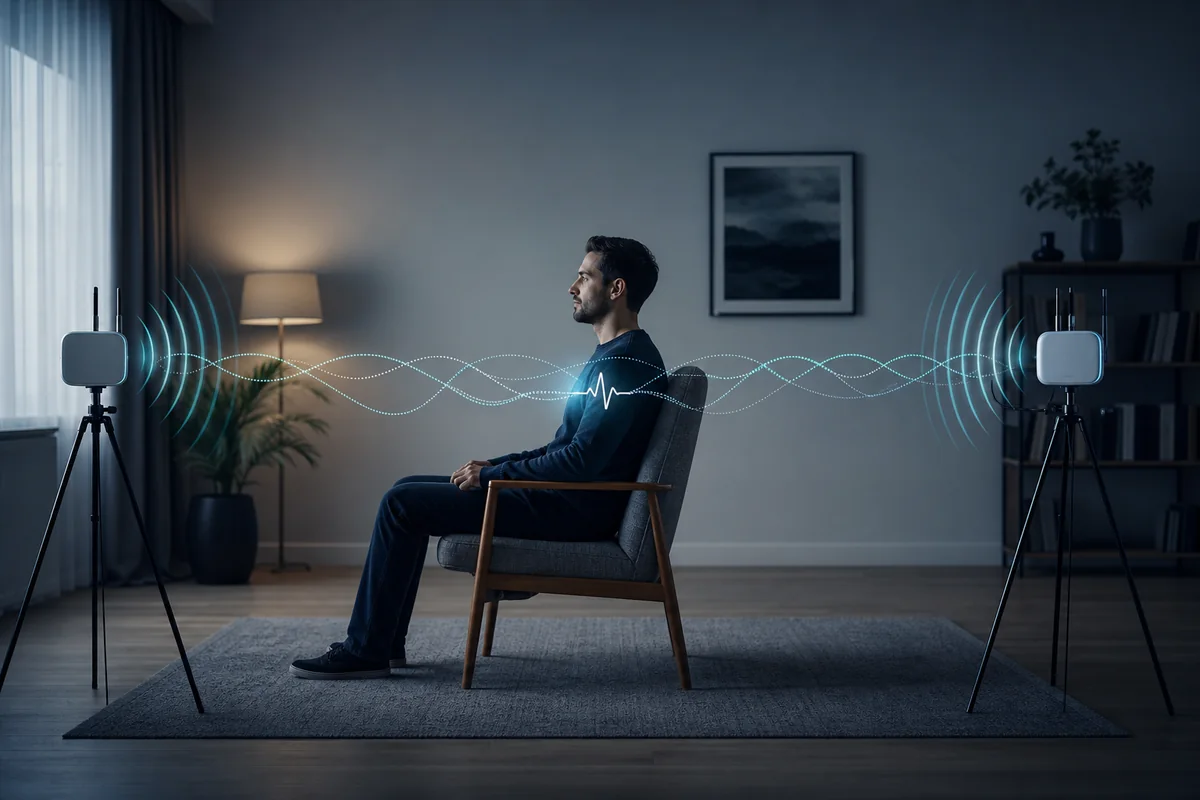
WiFi heartbeat detection is a research technique that estimates pulse-related chest motion from changes in wireless signals. A transmitter illuminates the room, a compatible receiver records channel state information (CSI), and software searches for a weak periodic component that may align with a reference heart-rate sensor.
The short answer is yes: researchers have demonstrated contactless heart-rate monitoring with ordinary WiFi waveforms and specialized receivers. The practical answer is more cautious. Breathing, posture, distance, multipath, packet timing, other people, and body movement can overwhelm the heartbeat component. A consumer router dashboard alone normally does not expose the calibrated CSI stream required for this task, and an experimental estimate must not be treated as diagnosis, emergency monitoring, or proof that a person is safe.
What WiFi heartbeat detection actually measures
A heartbeat causes extremely small mechanical motion in the chest and nearby tissue. Radio paths that reflect from the body change in phase and amplitude as that surface moves. CSI describes the response of multiple subcarriers between transmitter and receiver, giving a richer signal than a single RSSI strength number.
The receiver does not sense electrical cardiac activity like an ECG. It observes a mixture of propagation changes that may contain heartbeat, respiration, posture, device drift, and environmental motion. The model therefore estimates a physiological rhythm indirectly and needs a synchronized reference such as an ECG strap, chest belt, or validated optical sensor during development.
- Heartbeat is a weaker micro-motion component than ordinary body movement
- Breathing often has larger amplitude and must be separated
- CSI availability and stable packet timing matter more than router marketing labels
How the CSI heart-rate pipeline works
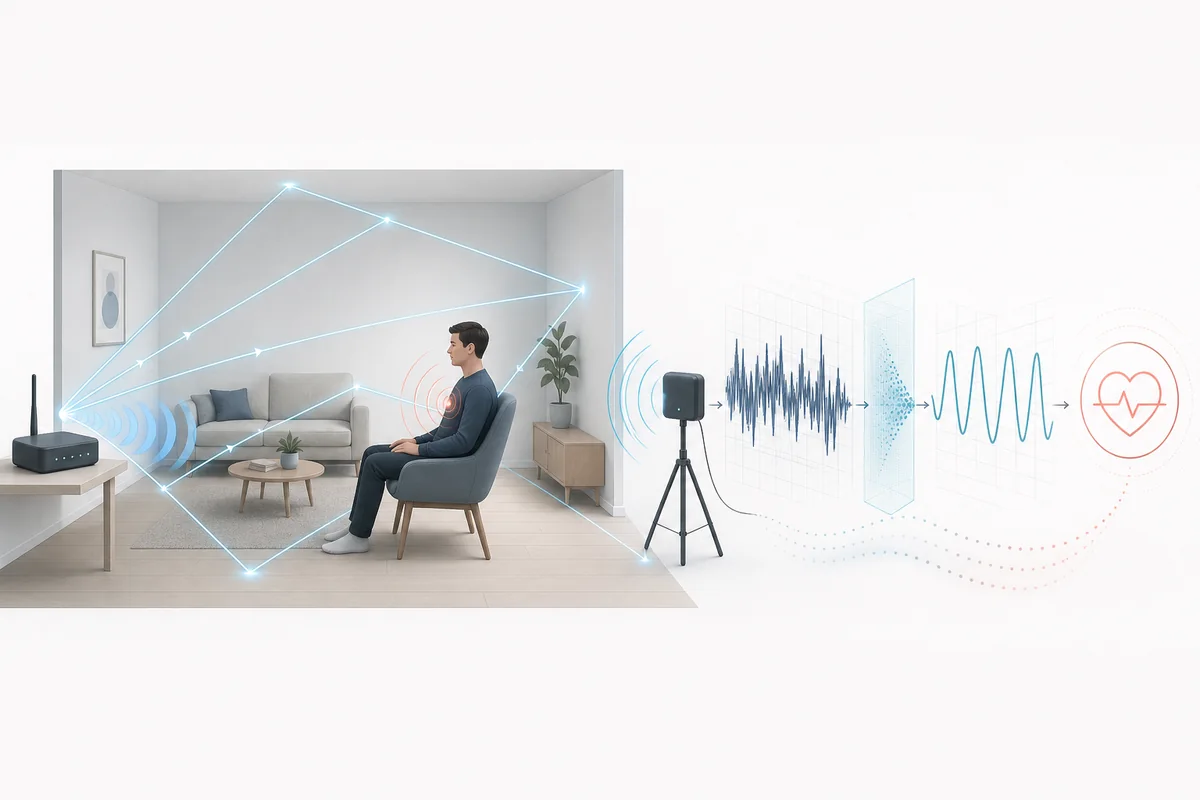
A typical pipeline starts with repeated packets on a stable link. The receiver logs CSI with timestamps, subcarrier values, antenna context, channel, bandwidth, and packet-quality fields. Processing removes broken packets, compensates phase or amplitude drift, combines useful subcarriers, suppresses slow trends and respiration, then searches the plausible heart-rate band for a consistent periodic component.
Modern systems may use principal components, adaptive filters, spectral analysis, beamforming, or learned models. More complex models do not remove the need for clean capture and subject-independent testing. If the raw channel is unstable, a smooth-looking output can simply be an artifact of filtering.
- Log raw CSI and packet context before calculating beats per minute
- Keep the transmitter, receiver, channel, posture, and distance documented
- Return an unknown state when signal quality or confidence is too low
Hardware and data requirements
The setup needs a transmitter, a receiver that exposes suitable channel measurements, stable traffic, and a ground-truth sensor. Research platforms have used WiFi network interface cards, software-defined radios, multi-antenna devices, and supported CSI toolchains. Some ESP32 families expose CSI for experiments, but performance depends on firmware, channel conditions, antenna design, sampling behavior, and the method being reproduced.
A single seated-person demo is not enough. Collect multiple sessions, people, distances, orientations, rooms, days, and interference conditions. Split training and evaluation by person and session when possible, because random sample splits can leak nearly identical signal windows into both sets and make accuracy look unrealistically high.
| Component | Minimum role | Common failure |
|---|---|---|
| WiFi link | Stable repeated packets | Rate or channel changes |
| CSI receiver | Subcarrier phase/amplitude with timestamps | Missing metadata or unstable clock |
| Reference sensor | Synchronized heart-rate ground truth | Loose alignment or unverified device |
| Test plan | New sessions and subjects | Testing on training-like windows |
What research evidence shows—and does not show
PhaseBeat demonstrated heart-rate monitoring with off-the-shelf WiFi devices by isolating periodic phase changes. NIST researchers later studied long-term respiratory and heart-rate monitoring and emphasized the difficulty of real environments. More recent Pulse-Fi work from UC Santa Cruz reported improved contactless heart-rate estimation with commodity WiFi hardware across multiple positions and participants.
These studies show feasibility, not universal consumer readiness. Reported errors come from specific hardware, rooms, subject populations, distances, reference devices, and evaluation protocols. They do not prove that any router can monitor any person, that results transfer through arbitrary walls, or that WiFi can replace an ECG, clinical wearable, or approved alarm system.
| Research direction | Useful lesson | Limit to remember |
|---|---|---|
| Phase-based WiFi sensing | Heartbeat can appear as periodic channel change | Motion and phase noise remain difficult |
| Long-term vital-sign monitoring | Continuous capture needs drift handling | Room and subject changes reduce transferability |
| Pulse-Fi | Commodity WiFi can support stronger estimates | A research prototype is not a medical device |
A validation workflow before trusting an estimate
First verify packet rate, missing data, CSI dimensions, timestamps, and antenna metadata. Record an empty-room baseline and then quiet seated sessions with a synchronized reference. Add controlled breathing, small posture changes, speaking, typing, and larger motion. Compare absolute error, coverage, and failure rate instead of publishing only the cleanest interval.
Next repeat on a different day, with a different person and device placement. Test whether the system correctly refuses to report when movement is excessive. A useful prototype includes signal-quality checks, confidence intervals or coverage, retained raw evidence, and a documented fallback.
- Evaluate by person and session, not only random windows
- Measure both error and the percentage of time a result is available
- Keep consent, local processing, retention limits, and visible controls in the design
Safety, privacy, and the RuView boundary
Contactless does not mean risk-free. Vital-sign patterns are sensitive data, and invisible sensing can undermine consent. Use the minimum data needed, process locally when practical, protect stored captures, and clearly indicate when sensing is active. Do not deploy an experimental system for diagnosis, medication decisions, emergency response, infant monitoring, workplace surveillance, or hidden monitoring.
RuView is useful for understanding the broader CSI sensing workflow, but the public demo is not a heart monitor. Use the RuView and ESP32 guides to learn capture, hardware, and validation concepts; use a verified reference sensor and the original research methods for any heartbeat experiment.
- Never interpret a missing estimate as proof that no medical problem exists
- Do not claim clinical accuracy without the required regulatory and clinical evidence
- Make unknown, low-confidence, and sensor-failure states visible
Research and technical sources
WiFi heartbeat detection FAQ
Can WiFi detect a heartbeat?
Research systems can estimate heartbeat-related motion in controlled conditions, but they require compatible channel measurements, signal processing, and validation against a reference sensor.
Can a normal WiFi router measure heart rate?
Usually not by itself. Most consumer routers do not expose the calibrated CSI stream, metadata, sampling stability, and validated model needed for a defensible estimate.
Is WiFi heart-rate monitoring accurate?
Accuracy depends on hardware, distance, posture, breathing, motion, room geometry, interference, subjects, and evaluation design. A published result cannot be assumed to transfer to another setup.
Can WiFi heartbeat detection replace an ECG or wearable?
No. It is an indirect research estimate and should not replace an ECG, medical wearable, diagnosis, or approved emergency alarm.
Does heartbeat sensing work through walls?
Some radio paths cross walls, but heartbeat micro-motion is weak and easily degraded. Wall material, distance, multipath, motion, and hardware can make a result unavailable or misleading.