Channel State Information simulation means producing a controllable signal that has the shape of CSI without claiming that it came from a real WiFi link. A simulator may generate complex values for subcarriers and antennas, apply a channel model, replay a captured trace with a measured perturbation, or create a small mock stream for a unit test. These paths solve different problems, so the first step is to name the result you need.
Synthetic CSI is useful when hardware is unavailable, preprocessing must be tested repeatedly, or a model needs a predictable edge case. It is not a substitute for measuring the target room: walls, gain control, antenna coupling, packet timing, firmware, and unrelated motion can change a real receiver. This guide shows how to use simulation honestly and plan the handoff to real capture.
What Channel State Information simulation actually produces
A CSI record is usually represented as complex values arranged by time, subcarrier, antenna, or spatial stream. A simulation can fill that structure with a deterministic pattern, a stochastic channel realization, or a replay derived from measured data. The array shape may look realistic while the physical meaning remains limited. A generated phase curve is a test input; it is not proof that a person moved through a room.
For a useful experiment, write down the assumptions next to the file: channel, bandwidth, subcarriers, antenna layout, sampling interval, noise model, motion pattern, and random seed. A reader should know whether the data tests array handling, a classifier, a visualization, or a physical hypothesis.
- Treat amplitude and phase as generated observations, not as a camera-like scene.
- Record dimensions, units, sample rate, channel assumptions, and the random seed.
- Label synthetic files so they cannot be mistaken for measurements in a training folder.
- Keep a real capture path whenever the final claim concerns a room or person.
Why simulate CSI before collecting hardware data?
Simulation shortens engineering feedback. It checks complex-number parsing, subcarrier order, missing packets, and repeatable result states before hardware is available.
Channel realizations can explore antenna layouts, delay, Doppler, and preprocessing, but they test model assumptions rather than a real home. Use simulation for bounded questions such as whether a transform preserves phase.
Three practical paths for synthetic CSI data
The simplest path is a mock CSI generator. The RuView testing source describes a generator for development and testing that can vary subcarriers, antennas, samples, noise, movement frequency, and movement amplitude. Its warning is part of the contract: the values are randomly generated and do not represent real WiFi signals. This path is ideal for tests, demos, and predictable failure cases.
A channel-realization path uses a propagation model to create a response from carrier, antenna, delay, Doppler, and sampling assumptions. MATLAB and other research tools can generate these realizations and transform them between frequency, delay, and angle domains. A third path starts from real CSI and applies a measured or explicitly documented perturbation. Replay is closer to a device than a purely mathematical model, but it inherits the limits of the original room and receiver.
| Path | Best for | Main caution |
|---|---|---|
| Mock generator | Unit tests, UI states, parser and shape checks | Random values are not physical measurements |
| Channel realization | Exploring propagation, arrays, delay, and Doppler | Model assumptions may omit receiver behavior |
| Trace replay plus perturbation | Regression tests and controlled robustness studies | The source trace limits what can generalize |
Build a reproducible CSI simulation pipeline
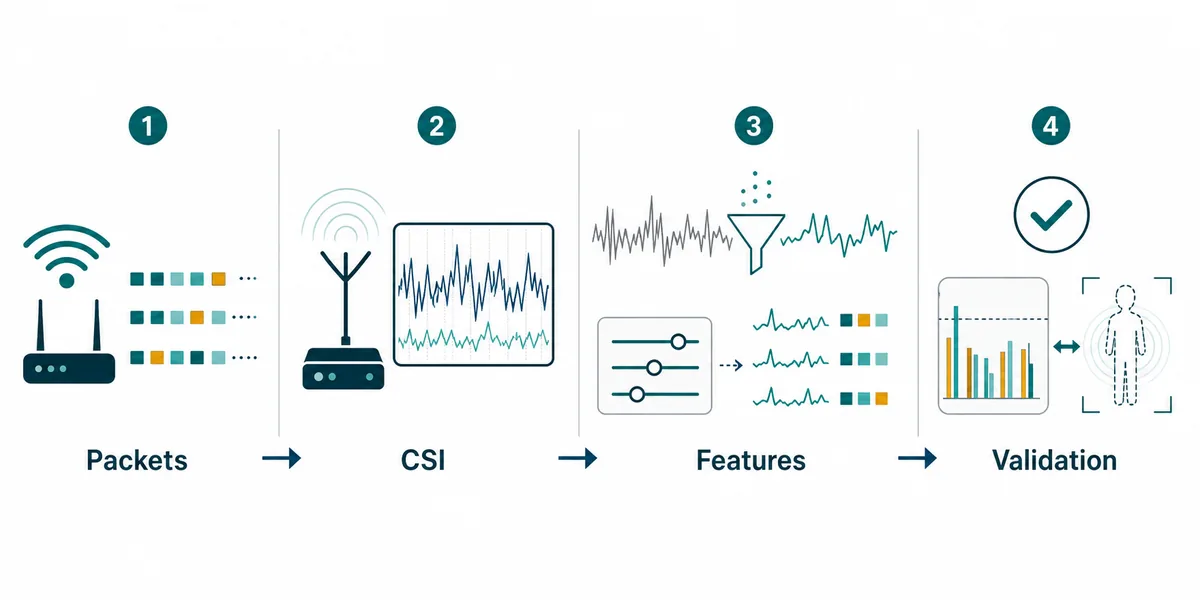
Start with a small contract rather than a large synthetic dataset. Define the tensor layout, complex-value convention, timestamp rule, and expected output of each stage. Generate one clean baseline, one moving target, one environmental distractor, and one missing-data case. Store the configuration beside each file so a future run can reproduce the exact signal.
Then run the same preprocessing that will be used for a real capture: packet selection, timestamp alignment, outlier handling, amplitude or phase normalization, windowing, and feature extraction. Do not let the simulator use privileged information that the receiver will not expose. If the real pipeline only receives noisy amplitude, testing it with perfect phase can make a later failure look mysterious.
- Freeze the random seed and version the generator or channel-model configuration.
- Keep raw synthetic values, processed features, labels, and split definitions separate.
- Add empty, stationary, moving, noisy, and missing-window cases before model tuning.
- Log the exact transform order so a real capture can follow the same path.
- Compare shapes, ranges, missingness, and temporal continuity before comparing accuracy.
Preprocessing choices change the meaning of a simulation
A complex CSI tensor is rarely sent directly to a model. Engineers may average over slots, permute antenna dimensions, transform frequency samples into a delay-angle representation, truncate weak delay components, split real and imaginary values, and normalize each feature. Each step changes what the next stage can learn. Documenting the transform is more valuable than calling a file “clean CSI.”
A MathWorks example generates channel realizations, reshapes antenna dimensions, transforms to a delay-angle view, truncates delay components, splits real and imaginary channels, and normalizes the result. Its settings depend on the carrier, array, delay profile, and training objective.
- Check whether averaging removes the movement detail your task needs.
- Keep the complex-to-real convention stable across synthetic and real data.
- Treat truncation as a trade-off between information, model size, and training cost.
- Fit normalization statistics on the training split when evaluating a model.
Why additive noise alone can mislead
Adding white Gaussian noise to a clean CSI array is an easy baseline, but it changes only one part of the signal. A 2026 CSI simulation study reports that automatic gain control can compress channel estimates multiplicatively before digitization. In that setting, an additive-noise variance cannot reproduce the observed amplitude distribution. The study evaluates six commodity receivers in two indoor environments and shows why a synthetic perturbation should be checked against measurements before it is used as evidence.
Additive noise is useful for a controlled disturbance or repeatable negative case. Label it an AWGN stress test. When fidelity matters, compare distributions, temporal behavior, correlation, missingness, and downstream performance with a held-out real trace.
- Name the noise model and the parameter used to generate it.
- Do not claim receiver realism from a single synthetic error curve.
- Use measured traces or calibrated transformations when the receiver chain is part of the claim.
- Keep the original real trace and synthetic derivative linked for inspection.
A practical handoff from simulation to ESP32 or RuView
Use simulation to make the first hardware session safer. Before connecting an ESP32 or another CSI receiver, verify the parser, storage format, feature code, and result states with synthetic files. Prepare a checklist for the board or NIC, channel, bandwidth, packet rate, antenna placement, firmware, clock, and empty-room baseline.
When real data arrives, keep it in a separate dataset namespace. Run the same preprocessing and compare dimensions, amplitude range, phase stability, packet gaps, and drift first. A synthetic-to-real failure is a domain gap to investigate; do not mix files until split and provenance remain visible.
- Pass a synthetic file through the full parser before the first hardware capture.
- Record an empty-room baseline and a controlled motion session with timestamps.
- Compare real and synthetic distributions before retraining or tuning thresholds.
- Use the ESP32 CSI guide for capture details and the accuracy guide for held-out tests.
- Keep RuView output framed as an experiment unless the physical validation supports a broader claim.
Limits, privacy, and what a simulation cannot prove
A synthetic CSI score proves that code ran on a defined input. It cannot prove that a router exposes CSI, that a person is detectable in a new room, or that an inference is safe for medical, security, or emergency use. Those claims need device-specific capture, labels, changed-condition tests, and privacy review.
CSI experiments can reveal occupancy, movement, routines, or breathing-related patterns. Use consent, limit retention, restrict access, and test deletion paths with generated data before collecting human traces.
- Mark synthetic files and plots clearly in notebooks, exports, and UI labels.
- Separate development confidence from physical-world accuracy.
- Test privacy and deletion behavior with generated data before collecting human traces.
Sources and technical references
Channel State Information Simulation FAQ
What is Channel State Information simulation?
It is the generation of controllable CSI-shaped data for testing, preprocessing, channel-model experiments, or replay studies. The output is synthetic unless it is explicitly derived from a measured trace.
Can synthetic CSI replace a real WiFi capture?
No. Synthetic CSI can validate code and explore assumptions, but a room or human-sensing claim still needs device-specific measurements, labels, and held-out tests.
What is a mock CSI generator good for?
A mock generator is useful for unit tests, parser checks, UI states, and repeatable edge cases such as noise, movement, missing windows, and fixed tensor shapes. Its random values should not be presented as real radio measurements.
Is adding Gaussian noise a realistic CSI simulator?
It is a clear stress test, but not automatically a realistic receiver model. Receiver effects such as automatic gain control can change amplitudes multiplicatively, so compare synthetic perturbations with real traces when fidelity matters.
How do I validate a CSI simulation pipeline?
Freeze the configuration and seed, check tensor shapes and ranges, run clean and missing-data cases through the same preprocessing, and compare temporal and cross-subcarrier behavior with a held-out real trace before making a physical claim.